
Applicant metrics
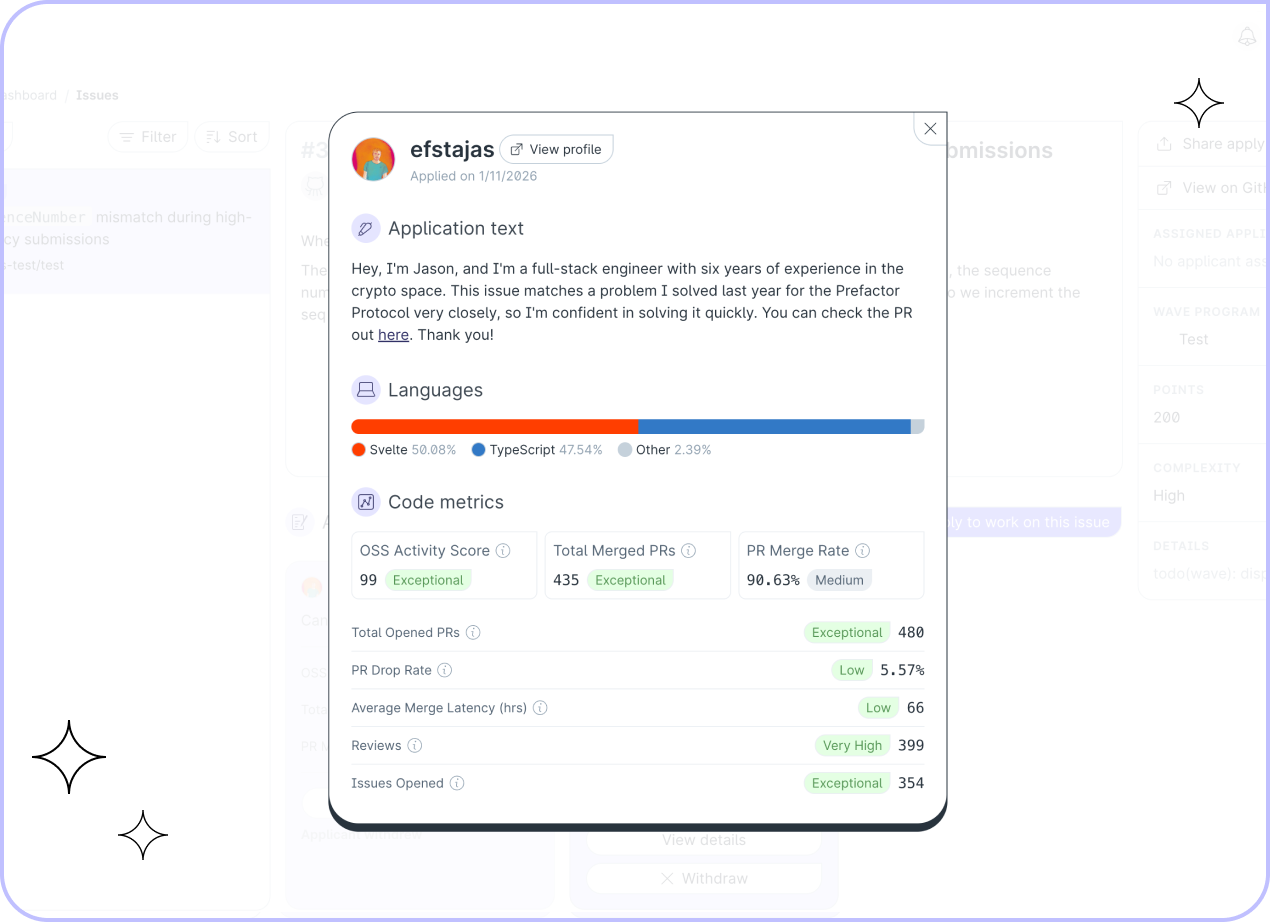
When contributors apply to work on an issue, maintainers see a Code Metrics scorecard summarizing their public GitHub activity. This page explains how each metric is calculated and what the categorical labels mean.
What Data Is Included
Rolling 3-Year Window
All Code Metrics are calculated over a rolling 3-year window (~1096 days), ending at the time metrics are computed.
Eligible Pull Requests
PR-based metrics only count pull requests that received at least one comment or one review. This filters out self-merges and automated dependency bumps, focusing on collaborative work.
Reviews and Issues
The Reviews and Issues Opened metrics come from your GitHub activity over the same rolling 3-year window.
How Bins Work
Each metric value is compared against a GitHub-wide benchmark of ~3.9 million users who opened at least one collaborative PR over a three-year reference period. Your percentile rank determines your categorical bin:
| Percentile Range | Bin |
|---|---|
| 0–24 | Very Low |
| 25–49 | Low |
| 50–74 | Medium |
| 75–89 | High |
| 90–98 | Very High |
| 99+ | Extremely High |
Metric Calculations
OSS Activity Score
A composite score summarizing open-source collaboration activity.
Formula:OSS Activity Score = (0.40 × Reviews percentile) + (0.35 × PRs Opened percentile) + (0.25 × Issues Opened percentile)
Each component is first converted to a percentile against the benchmark, then combined. The resulting score is itself compared to the benchmark for OSS Activity Scores to determine the bin.
Total Opened PRs
Formula: count(eligible PRs created in window)
Compared against benchmark thresholds for opened PR counts.
Total Merged PRs
Formula: count(eligible PRs created in window where state = MERGED)
Compared against benchmark thresholds for merged PR counts.
PR Merge Rate
Formula: Total Merged PRs / Total Opened PRs
A ratio from 0–100%. Compared against benchmark thresholds for merge rates.
PR Drop Rate
Formula: Closed without merge / Opened non-draft PRs
Draft PRs are excluded. Lower values are better for this metric.
Average Merge Latency (hrs)
Formula: mean(merged_at - created_at) across eligible merged PRs, in hours.
Lower values are better for this metric.
Reviews
Formula: count(PR reviews submitted in window)
Compared against benchmark thresholds for review counts.
Issues Opened
Formula: count(issues opened in window)
Compared against benchmark thresholds for issue counts.
When a Bin May Be Hidden
Bins require enough activity to be statistically meaningful. You may see the raw value while the bin is hidden.
| Metric | Bin Appears When |
|---|---|
| Total Opened PRs | ≥ 1 eligible PR |
| Total Merged PRs | ≥ 1 eligible PR |
| PR Merge Rate | ≥ 20 eligible PRs opened |
| PR Drop Rate | ≥ 20 eligible non-draft PRs opened |
| Average Merge Latency | ≥ 20 eligible merged PRs |
| Reviews, Issues Opened, OSS Activity Score | ≥ 10 total OSS activities (PRs + Reviews + Issues) and ≥ 1 eligible PR |
Languages Profile
The Languages section shows your programming language breakdown as percentages, computed across your lifetime PR history (not windowed).
For each PR, a weight is calculated from additions + deletions (or changed_files if zero). This weight is distributed across languages using the repository's language breakdown, then normalized into a final percentage.
Population Baseline
Benchmark thresholds are derived from GitHub Archive data covering October 2022 through September 2025. This baseline is fixed because GitHub's Events API changed its payload structure in late 2025, preventing consistent extension. Your individual metrics are still computed fresh from the GitHub GraphQL API—only the population reference points are frozen.
Frequently Asked Questions
How often are my metrics updated?
Your metrics are computed when you first sign up for Drips Wave. After that, they are refreshed periodically via a background process. The rolling 3-year window moves forward with each refresh, so your metrics will naturally reflect your most recent activity over time.
Why don't my GitHub stats match exactly?
The scorecard applies filters that differ from GitHub's default profile views. Only PRs that received at least one comment or review are counted, which excludes self-merges and automated dependency bumps. Additionally, all metrics except the language profile are calculated over a rolling 3-year window rather than your full history, and only public repositories are included.
Why do my metrics show "Unknown" or "Not enough data" despite having activity?
If your GitHub account has enough data to satisfy the minimum thresholds for a metric but still shows "Unknown," the metrics may still be computing in the background. This process can take some time after initially signing up. If it's been more than an hour and you still see "Unknown," please contact support.